

Long May He Leap
A meander about a beautiful buck, food traditions, gender tropes, and what sustains a mostly plant eater.

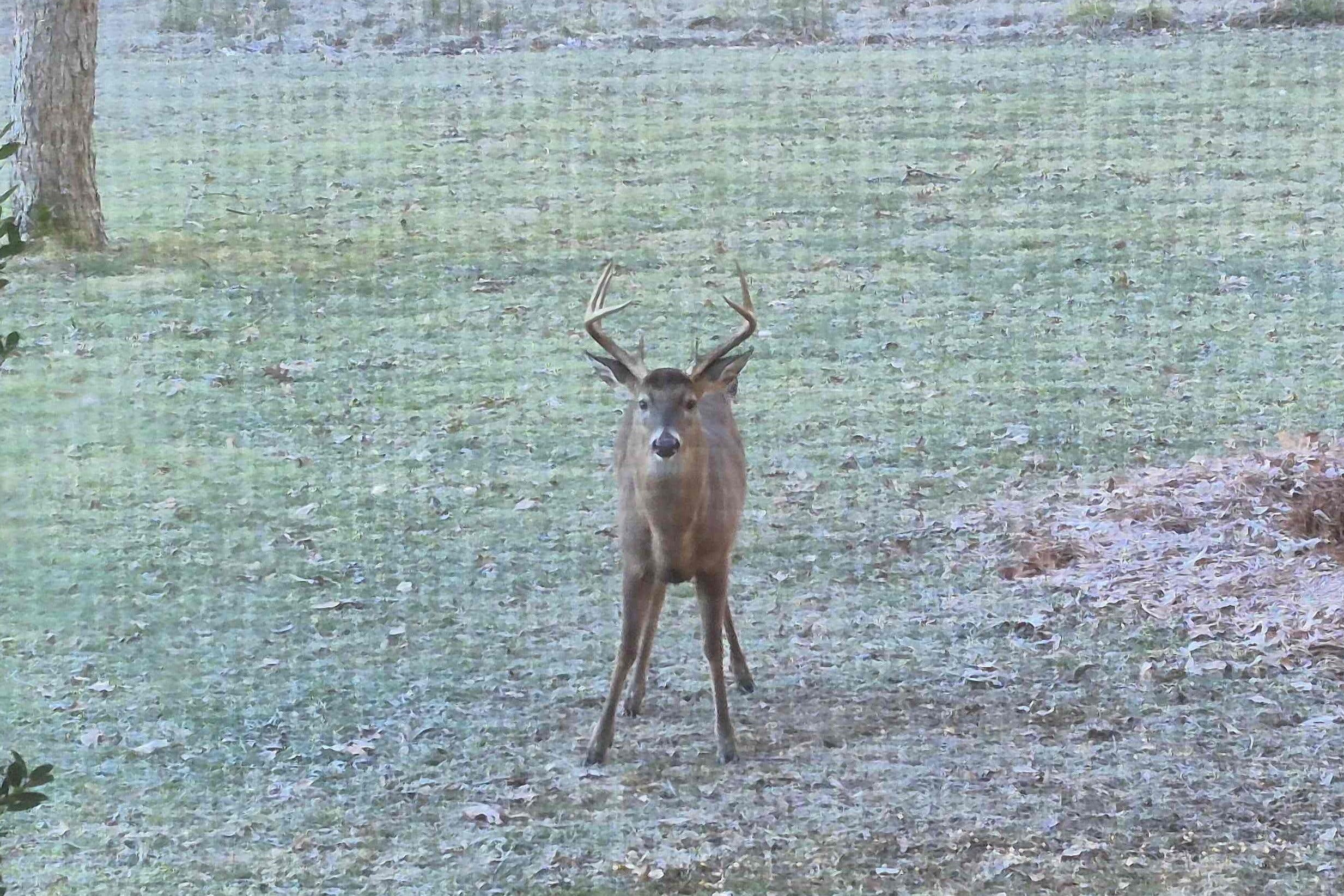
The fawn was about five months old when my husband and I moved to the woods. The baby was part of a herd that crossed our land every late afternoon. With them, he watched as one of us stepped out to sprinkle dried corn beyond the porch steps. He learned, with the rest, the rattling sound we made with the container, which meant a snack was ready. The deer came as if we’d rung a bell.
He looked like the other two fawns who came with their mothers. At a year, then two, when the males were no longer with the females, he was still not identifiable on his own. By then, there were three young males who rarely showed themselves, all of them chased off by the does if they tried to have a treat with the group.
Last December, he stood out, then about three and a half years old. His antlers had grown. His chest had broadened. His face had an unexpected innocence. If I spotted him alone or with some younger males, I walked out to greet him and rattle the promise of a nibble. His reaction let me know he remembered the routine. Once I can recognize an animal by a unique quality—a scar, the fur’s color—I typically name them. But I didn’t give him a proper one. I referred to him as Buck Boy. While I watched him with respect, that I could be several yards away from a being that beautiful, I feared for him.
Beyond our land, a few acres in any direction, hunting is allowed. I flinch with every shot I hear, wondering who will no longer show up for their snack.
This may be why I hadn’t named him.
*****
I grew up in Louisiana, the Sportsman’s Paradise, in Cajun country where hunting and fishing are as common to the culture as the flat-sounding accent. Some men in my family fished, but few, if any, hunted. There was no escape from the awareness of it—NRA stickers, camouflage, commercials and ads, mounted heads in homes and restaurants.
As a child, I tried venison sausage, a taste that lingers in memory with a hint of metal so sharp, it’s blood and the bullet. I never ate game meat again.
Pork, beef, and poultry, sure I ate that, because it’s what was served to me. My mom made a well-seasoned skillet-fried hamburger. When the mood struck him, my dad methodically poked garlic slivers into a roast he’d cook with potatoes and carrots. Summer Sundays featured my grandfather’s barbequed chicken, covered in a sweet sauce he mopped on in layers. My grandmother made braciolone, a recipe from my Sicilian great-grandmother—a thin round steak filled with chopped boiled eggs, parsley, celery, and seasoned bread crumbs, rolled and tied with string, seared on all sides, then simmered in thick tomato sauce.
Once I learned to cook for myself, I continued to eat meat without question until eventually I did. The physical response came first, though. New Year’s Day, 2001, I stared into the bloody center of a steak and forced down the bite against a mighty gag. From then on, portions of homecooked roast beef became smaller until I only ate the carrots and potatoes. A tiny bit of gristle in a hamburger turned my stomach. Chicken smelled funny, looked funny.
Within a year, I stopped eating what once had fur or feathers to see how my body reacted. I felt better. Lighter. Clearer.
When invited to meals with friends and family, my feel-better-physically reason why I didn’t eat meat was an acceptable one that people didn’t question or challenge. This caused no friction, unlike what was happening under the surface. I believed animals were sentient, with their own mental and emotional experiences, and this compelled me to reflect on their suffering. I knew the violence involved with a hunt, having seen this on TV and in movies. I knew pigs, cows, chickens, and turkeys were killed to be my dinner, but I was in my thirties before I contemplated how that was done and what it meant. The living conditions of animals who are raised to be food and to provide it. What they are fed, often unlike what they would forage if they were wild. How they are transported then slaughtered. The impact on the land and water.
I didn’t become vegan, instead more mindful—eating a fraction of the dairy and eggs, as well as seafood and honey, I once did, sometimes none at all for months at a time. This was the right choice for me. That’s it.
*****
When the incessant barking started, I thought it was our neighbor’s dogs who got loose, as the rambunctious Weimaraners sometimes did. My husband heard the commotion, too, and went out to spot two dogs chasing a buck near our house and into the pond. He asked me to contact the neighbor while he tried to distract them.
I texted to find out if her dogs were with her. “Yes. Sleeping. They say it’s too cold to be outside for long. Bleepin’ hunters. Dog season is open.” It was early January.
From the porch, I watched my husband at the pond’s edge, shouting at the dogs who paddled behind the swimming buck. “Not theirs,” I called to him. We could see one dog was a black lab with a red collar, the other a mixed breed.
The buck—my buck boy, closing in on his fourth birthday—approached the pond’s east side and tried to get a footing on the too-steep bank. The dogs nipped at his legs (I thought I saw blood), and my buck splashed back into the water, exhausted, as the dogs pursued him like boys playing chase.
“I’m getting the shotgun,” my husband said and went into the house.
The gun had belonged to his father, who had hunted as a younger man and took his son to teach him the “sport,” which didn’t interest the boy who very much loved animals. Cajun men are Cajun men, so my husband kept his father’s gun although he had no intention to use it. Until then.
As my buck and the dogs crossed the pond again, I witnessed my buck’s waning strength. My head swam with conflicting thoughts. deep down, the dogs have wild instincts from before they were dogs…fucking hunters training their animals to do this…stupid dogs, chasing my buck like it’s a game.
My husband walked across the porch then the stretch of grass to the pond, pointed the gun low toward the woods with the ease of genetic memory, and fired one, loud shot.
The dogs looked around, startled. In their confused pause, the buck reached the pond’s edge, dug in his hooves, and ran into the trees. The dogs paddled to land and took off running in the buck’s direction.
Shaking and sick as if I’d been the prey, I willed my buck boy the strength to flee. His rack was too small for a good trophy, but he was big enough for multiple hearty meals. How long would I have to wait to find out if he lived?
****
The first April in the woods (my buck boy almost at his first birthday), we needed to have trees cut down that were too close to the house. The company we used in the city from where we’d moved agreed to drive out to our property for the job.
I had a good rapport with the owner and crew chief, two men who appreciated trees and pruned, trimmed, and felled them for a living. When we were in the city, the owner kept an eye on my favorite swamp chestnut. When he said it was time for it to come down before it fell on our old house, I trusted his judgement. The crew chief and I, in previous conversations, got along fine. He thought it was interesting I was a writer, and I found it interesting he did woodwork.
So that spring, the team arrived with their saws, crane, tractor, and chipper. Because there was no place to get a quick lunch, they packed what they needed to barbeque. During their break, the crew chief fired up the pit he brought. My husband and I helped them set up, got paper towels and cups.
“Do you want a burger?” the crew chief asked me.
“No, thanks. I don’t eat meat,” I replied. “I haven’t in about 20 years.”
I probably told him I stopped eating meat to see if I’d feel better and I did. It’s possible I shared that I believed animals were sentient and I’d prefer not to eat them. There is no way I mentioned personal ethics, the cruelty of factory farms, or the concepts of permaculture and humane husbandry. I got into that only if questioned and only if I felt safe enough to talk about it, which, from what I sensed about him, it wouldn’t have been.
The brief conversation with the crew chief was one I’d had multiple times with others over the years. I thought nothing of it and went back into the house. Later, I learned my husband was angry at me for what I said. Turns out, the crew chief gave him a hard time that he wasn’t fed meat in our home.
Right... Instead of saying that to me, giving me the chance to call out the toxic masculine bullshit for what it was, the crew chief chose to shame my husband with the implication real men eat animals and that I’m not sufficiently cowed to cook them for him.
Had there been ham sandwiches that April day, a different conversation, if I’d talked about how much I loved living surrounded by trees and seeing the deer and how I worried about them through the hunting season—would I have walked away as the crew chief rolled his eyes at my affection and empathy? Would he have teased my husband for choosing a partner with a womanly heart?
*****
Last week, I visited with an ecologist and a cultural archeologist to pick their brains for a research project. They are my people, whose accents go flat with certain words and phrases, who have respect for the land and Cajun history of our ancestors. I learned more in three hours than I could have in days of skimming through books and articles.
At our break, Miss L___, the ecologist’s wife, served us tea and gateau sirop, syrup cake. I damn near fell out of my chair with the first bite, the burst of fruit a culinary plot twist to a dessert I’d had many times before. “Orange peel,” she said. “It’s a family recipe.” My fork sliced into the moist cake, dense with tradition, eggs, and butter.
She and her husband had lived in the woods for forty-five years. The transition to a traditional city neighborhood was hard. A former animal rescuer and wildlife rehabilitator, she told me of the animals she’d cared for—birds, squirrels, raccoons, possums, two bear cubs, a fawn. The fawn was the first and only because the baby had imprinted on her. From then on, she sent fawns who came into her care to other rescuers and, reluctantly, to deer farms.
Deer farms. I sipped my tea as the something-else-new-I-learned-today weighed down my heart. Miss L___ said she was glad the farms didn’t take animals from the wild, but it was difficult to know the deer would be raised and sold to hunting clubs.
Violence is fact for earthbound beings. Predator and prey, once in balance. Long-ago human ancestors killed the animals they needed to survive; less-long-ago, learned to pen and cull them, killed others into extinction or nearly. The question of whether it’s right or wrong to use creatures for food, that’s not what gnaws at me. It’s the suffering, the scale of it. The family farms that sustained small communities replaced by corporate corrals, pens, and cages. Excess millions of pounds of flesh feeding gluttony more than bellies. The pleasure I don’t understand in killing a wild being.
I didn’t ask Miss L___ any questions about these farms. We spoke instead of our love for the woods, the quiet, the darkness, oh, the darkness. When I told her about the black bear I’d seen on a walk, she blurted the only adjective I use to describe how I felt. “Awe,” she said, her eyes tearful with understanding.
I told her how I love to see my deer gather for their afternoon treats, about my buck boy who is magnificent as he jumps among the trees, about my concern every winter as the hunters come out.
“When they hear the shots,” she said, “they know where to go.”
Home again, I thought of her words. Our few acres, the ones surrounding us, a refuge. The deers’ presence, nourishment. The does and not-quite-yearlings are all accounted for as they straddle over the dotted lines of yellow kernels. They splinter off, head for the worn trails through the tall grass and ravines. My buck boy circles the territory, keeps his distance, vaults over the fallen leaves with his head high.
Cernunnos, I’ll call him. Cern for short.

I love this, Ronlyn. I’ve been vegetarian for over 45 years, long before I understood the word. I ate chicken for a short while in my thirties and it didn’t feel right. I knew without knowing. It was not for me. Thank you for putting words to something so personal, so heartfelt.
Beautiful!