

Whitewashed Roots?
An AI-generated image blurs the mystery of a Cajun lineage.

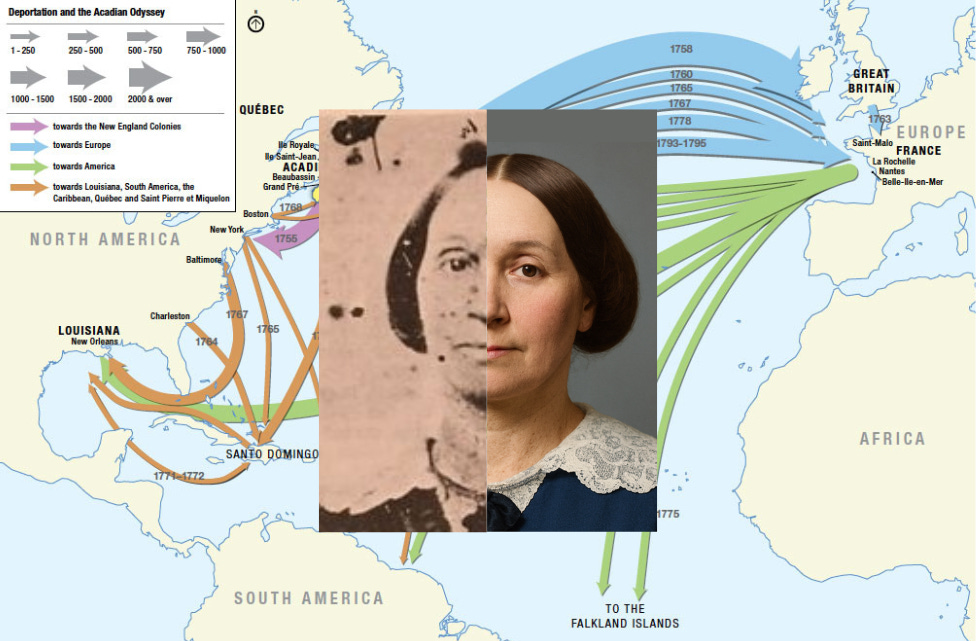
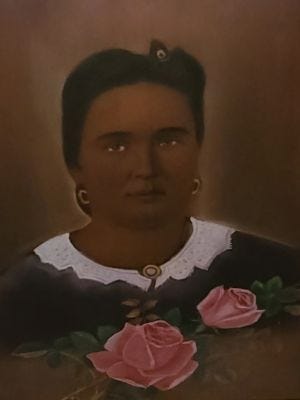
In my paternal grandparents’ house, a painting hung in the hallway, later in the dining room, of a woman with dark skin. Two pink roses under her white collar looked even brighter against the sepia, brown, and black tones. One of my grandfather’s Spanish ancestors, I assumed. My grandfather’s, and my, last name should have a Z at the end; the lore of its loss is that the dropped letter turned the surname French in pronunciation. In Cajun country, that made sense.
If someone told me who the woman was, I forgot. She looked at us gathered around the dinner table. One of my aunts vaguely resembled her, but the rest of us had light eyes and light skin. The ancestor remained a beautiful enigma.
***
In my thirties, my maternal grandmother gave me her genealogy notebook and files. One spiral-bound notebook had names and dates that she, if I remember correctly, wrote herself while going through records at St. Louis Cathedral in New Orleans. A folder held genealogical society newsletters, random family trees, and handwritten notes from other sleuths. For her birthday, I compiled what she gave me into several charts. I never pointed out she was born less than seven months after her parents married or remarked on the number of cousin intermarriages.
She had photographs on shelves and walls, but the generations didn’t stretch back that far. I knew what my Sicilian great-grandparents looked like—my grandfather’s people—yet I can’t recall if she displayed any of her parents, the mother who died when she was eight, the father who died when I was two.
Almost 20 years would pass before I’d try to confirm what she handed over and trace the many branches that stretched to me.
***
Ancestry and Family Search, starting in 2018. The first digs led to public family trees, which were often copied and pasted from other people’s trees with no verification of facts. Incorrect dates—a great-grandfather cannot be younger than one’s grandfather—and inconsistent names compelled me to sketch out what might be true and strike out to confirm what I had.
Scanned US Census records; marriage, birth, and death certificates; newspaper articles; and other documents offered breadcrumbs. With that old paper, I followed the trails, stopping to jot down who was born, baptized, married, and died and when.
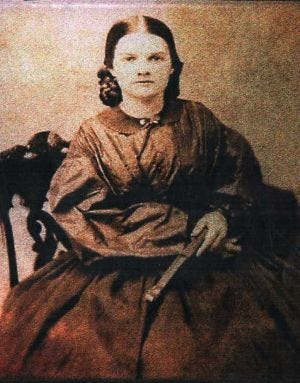
Far-distant cousins uploaded photographs I could only hope were correctly identified. One cousin, whose tree details proved to be reliable, shared an image that made me gasp the first time I saw it. My great-great-great grandmother Theresa, wearing a dress that seemed too big for her, sternly facing the camera. I knew from her daughter’s brief autobiography—one of the documents my grandmother handed over—that Theresa had been a teacher. And there she was, looking back at me, a young widow and mother whose husband went off to the Civil War and never returned.
Then came Marie. My great-great-great-great grandmother.
Marie was on my paternal grandmother’s tree, the branches that belonged to her father. According to the paper trail, this lineage is almost purely Cajun.
The deep, oversimplified backstory matters here.
In the early 1600s, French peasants began to colonize what is now the area of and around Nova Scotia. Many came from France’s Poitou region, some from Brittany, some from Normandy. For several decades, more French people crossed the Atlantic and joined what would become an isolated ethnic group known as the Acadians. Over time, the French and English battled over the territory. The Acadian people were called French neutrals because they wanted to be left alone to their families and farms with no allegiance to either side. For generations, they relied on and intermarried with the native Mik’maq people.
In 1755, the English started the first round of an ethnic cleansing—Le Grand Dérangement. The Acadians’ farms and homes were burned. Separated families were exiled, forced onto ships that left them along the American eastern coast, the Caribbean, France, and England. Those who remained in the Nova Scotia area were imprisoned, unless they were able to flee and hide.
Ten years later, with the promise of land from the Spanish government which then had control over what is now Louisiana, a group of Acadians arrived to colonize near Bayou Teche. Again, they depended on the native peoples—Chitimacha, Ishak (Attakapas)—for their survival. Many Acadians, later known as Cajuns, once again worked as subsistent farmers and cattle ranchers. Some also became enslavers. For two decades, along the bayous, marshlands, and prairies of what is now South Louisiana, separated families reunited and tried to recreate the lives they had before their exile.
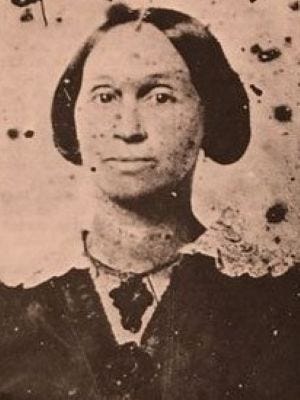
When I found Marie, her image appeared to be part of a document, perhaps a newsletter clipping, that wasn’t identified. Under her photo, someone had written her name, the years of her birth and death, and the name of her husband.
I was thrilled to see a great-great-great-great grandmother and surprised she wasn’t what I expected. I grew up among my grandmother’s large family, and no one I remembered resembled this woman with the appraising expression. To my eyes, she looked like someone who could have indigenous or African ancestry. Based on the paper trail, she couldn’t be Creole. She was from the second generation born in what was then the United States, six generations removed from the original colonizers in Nova Scotia. Every name I encountered in my research was European in origin. There were Europeans with darker skin tones; were her ancestors from any of those regions?
Months later, when I received my DNA results and compared them with my parents, on my father’s side, there was a trace of indigenous American DNA. Hmmm. What ancestor carried that blood? Were they connected to Marie? Perhaps with extensive cross-referencing with many distant cousins, I could learn who that ancestor was, but I will likely never know.
***
Last year, at the start of a new research project, I started to circle back on my ancestors. Like every other turn on this particular spiral, it leads to new connections, unexpected discoveries.
So, when the trail led me to Marie again—who had anywhere from 16 to 22 children, depending on the source—I returned to her Find a Grave page. At the top of the page, instead of the picture I downloaded years before, someone had replaced the main photo.
Marie had been whitewashed. The AI-generated face echoed the flesh-and-blood Marie’s features, but she was now, from my perspective, paler and more conventionally “pretty.”
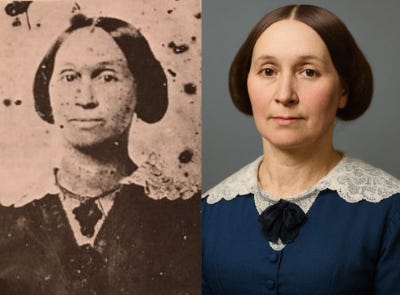
The original image was still viewable on the site when I scrolled down. But what compelled someone to not only generate a distortion of her but prioritize it for others to see? Why the unnecessary likeness when there is a good photo of her already? At the very least, why not refine the prompt to match her characteristics and complexion more accurately?
Tirades and revelations followed.
In a text thread with my genealogy-loving aunt, she asked if this Marie was the woman in the portrait in my grandparents’ dining room. I knew she wasn’t, although I couldn’t remember her name at the moment. Before my grandmother died, still sharp in mind at the age of 101, I had bothered to ask who she was. I saw her every time I visited MawMaw in her assisted living apartment.
I checked my computer files. Boom.
The portrait was of Leontine, Marie’s daughter. Find a Grave click here, click there, and I learned, in 1867, Marie, Leontine, one of her children, two of Leontine’s brothers, and one sister all died in a yellow fever epidemic within weeks of each other. In the New Orleans’ Times-Picayune, using an obituary list from St. Martinville, they appear among the dead. “—Total 133. To this list, deficient as it is, we must add one-fourth as many more for the negroes who have died, if we would form a tolerably correct idea up to the present time, 26th October.”
When she died, my great-great-great grandmother Leontine was 28 years old. At least three young children were left motherless, among them, my great-great grandmother, also named Marie.
***
In the first months of tracing my ancestors, it was frustrating to wade through public family trees on genealogy sites filled with mistakes and misinformation. My effort to find my own people was because I wanted to know who they were, genuinely, from the distant cousin who was a late 19th century author and educator to the great-great-great grandfather who enslaved 14 human beings. To learn this, I had to be curious and dig. I had to want the facts, and the truth.
The whitewashed image of Marie…it’s going to spread like a virus. Some descendants will decide they like the not-Marie better—because the image has no blemishes, because she looks “white,” because…—and that’s what will get used over and over again. I’d rather have no clue what an ancestor looked like than a depiction spewed from a technology that has no lineage or soul.
My aunt and I don’t know if Leontine’s memorial portrait—almost certainly so because of the roses’ presence—was done right after her death or from a photograph, but whoever did it attempted an appropriate likeness. When my aunt takes Leontine’s painting to get re-framed with museum-grade glass, she will take a photo of it so we have a better image. One of us will upload the photo on various sites. Soon after, I suspect, someone will do to Leontine what was done to Marie.
Give me mystery and complexity, nothing polished, full of tangles. Maybe Marie and Leontine’s skin tones reveal the dark complexion of their ancestors whose genes clustered for centuries in current-day France, their ancestors from distant places, traceable in patterned codes of A, C, G, and T. Maybe mother and daughter are the descendants of people from two continents, two different cultures, one of them considered a savage by the Catholic church that baptized their child.
A firm answer isn’t needed. Just the truth, as far as I can see it.

Amazing! And creepy to imagine what was going through that person's mind, when they photoshopped to literally whitewash a racial heritage!
Wow!!! I admire your sleuthing! And what a bizarrely wrong image.